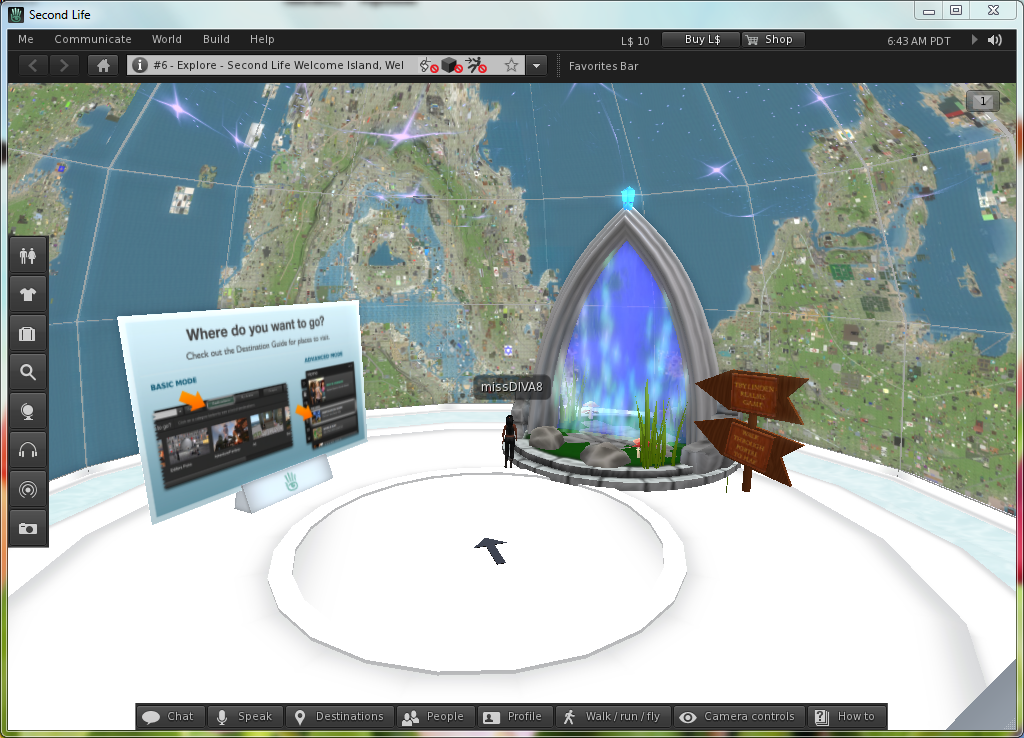
Boy oh boy! I just spent most my morning in Second Life on Eagle's Island. The controls are sometimes impossible and I did get frustrated. However, it was quite gratifying when I mastered the controls and got my avatar to fly, sit, run, and roam around the island! *light bulb* Soooooo, this has to be the feeling of gratification that I have researched about and even mentioned in my gamification video. Oh the irony right?!
Well, aside from feeling just a bit accomplished here, I am still not #teamSecondLife. I can see the benefits and it is interesting but it I do honestly believe moving around could be made a little easier. Although, I did see where SL is constantly updating, fixing glitches, and improving its current state. That in itself is nice to know.
I think I may need to keep at it. I mean the saying does goes, "Practice makes perfect", or was it "practice in second life is going to drive Jay crazy!" Either one I need to move and learn how to navigate more efficiently. I still have leaves in my hair from hitting that tree!
Below are some pics from adventure on Eagle Island!
Welcome! “It is not about the technology; it’s about sharing knowledge and information, communicating efficiently, building learning communities and creating a culture of professionalism in schools. These are the key responsibilities of all educational leaders”. – Marion Ginapolis
Friday, April 12, 2013
Thursday, April 11, 2013
Second Life WELCOME!
I have tried my very best to enjoy and like Second Life. But honestly, I am not a fan. I can do a laundry list of things that I just don't like about it actually. However, the welcome island tour was nice and it forced me to navigate through a little better.
I am still having some trouble positively connecting Second Life to education. But I do think that stems from my distaste for the application prior to this course. I can see some benefits but my apprehensions seem to out weight them. Second Life is by no means horrible. I have actually been thinking of ways to incorporate it into a lesson or an activity so I can make more sense of the use and potential benefits it could have for students.
So for now, I will continue to "walk" through and figure out ways to wrap my brain around my Second Life!
I am still having some trouble positively connecting Second Life to education. But I do think that stems from my distaste for the application prior to this course. I can see some benefits but my apprehensions seem to out weight them. Second Life is by no means horrible. I have actually been thinking of ways to incorporate it into a lesson or an activity so I can make more sense of the use and potential benefits it could have for students.
So for now, I will continue to "walk" through and figure out ways to wrap my brain around my Second Life!
Tuesday, February 12, 2013
Second Life. . .
Surprising to me I joined second life one year and 3 months ago at the request of my supervisor. He said he indulged for fun and that I should set up an account and see for myself. He was quite fond of it and I seen him on it a few times while at work. At his suggestion, I got an account and downloaded it to my work computer. I hated it! I know, I know. Buuuuut give me a chance to explain.
Just moments ago I set up a new account and put it back on my computer at work. When it finally logged me in it was the old account. I left it that way and started to "look" around. Instantly I had some friend request invites and some teleport invites. I am still unsure of how to use Second Life or request anything of others just yet. I did however figure out to chat and ask how on earth do I use this thingy!
Now, I may be taking a leap here and some may disagree. But I am not enthused nor do I see the positive and for sure I do not see the user friendly effectiveness of participating in a second life. I read a few articles and listened to a few gaming videos about pros vs cons of actively participating in second life but I can not fathom the implications it would have on education. Or it could just be the virtual world in which I am existing as an avatar at the moment. As I type this blog, I am switching back and forth from second life and trying my best to produce a blog that is both reflective of my opinion but also a blog that is conducive to the instructions of the Game Lab for this particular quest.
I was not too fond of second life when I was introduced to it over a year ago and after surfing...oops..let me say "living" in second life for most of the morning, I am not sold on how it can be great for educational purposes. I am struggling to see where a blog or podcast or even a game with quests like Game Lab or discussion like that on BlackBoard doesn't somehow serve a better purpose than sitting in front of a computer living vicariously through an avatar of your choice with people you don't know.
Now, maybe I need to broadened my scope of the situation at hand. Maybe I need to dig deeper. Or maybe I need to think outside of the box so that I can really see how practical this could potentially be for education, teachers, and most importantly students. I can't help but think of the very communication process itself. Rhetoric as we know it has changed immensely since the emerging and now monopoly of electronic devices and their vast capabilities. So many other forms of communication have replaced the actual "talk". Second life seems very informal to me. I am all for being comfortable and even support unconventional methods of teaching and learning. I am just not sure if I am agree (especially with younger students) and the self esteem issues that arise around the puberty age if hiding (if you will) behind an avatar is the best way to enhance and promote learning outside the classroom. I do think it is important to enhance social skills and in my mind a Skype session or discussion board or wimba or VoiceThread or oovoo or many other types of applications may be more practical than second life.
Seeing as though I am not exactly a fan of second life....I must do some more research outside of actually participating in the "game" to clarify some things for me. With that being said, I look forward to seeing, reading, hearing the views of others because it is just not clicking for me. . .
Just moments ago I set up a new account and put it back on my computer at work. When it finally logged me in it was the old account. I left it that way and started to "look" around. Instantly I had some friend request invites and some teleport invites. I am still unsure of how to use Second Life or request anything of others just yet. I did however figure out to chat and ask how on earth do I use this thingy!
Now, I may be taking a leap here and some may disagree. But I am not enthused nor do I see the positive and for sure I do not see the user friendly effectiveness of participating in a second life. I read a few articles and listened to a few gaming videos about pros vs cons of actively participating in second life but I can not fathom the implications it would have on education. Or it could just be the virtual world in which I am existing as an avatar at the moment. As I type this blog, I am switching back and forth from second life and trying my best to produce a blog that is both reflective of my opinion but also a blog that is conducive to the instructions of the Game Lab for this particular quest.
I was not too fond of second life when I was introduced to it over a year ago and after surfing...oops..let me say "living" in second life for most of the morning, I am not sold on how it can be great for educational purposes. I am struggling to see where a blog or podcast or even a game with quests like Game Lab or discussion like that on BlackBoard doesn't somehow serve a better purpose than sitting in front of a computer living vicariously through an avatar of your choice with people you don't know.
Now, maybe I need to broadened my scope of the situation at hand. Maybe I need to dig deeper. Or maybe I need to think outside of the box so that I can really see how practical this could potentially be for education, teachers, and most importantly students. I can't help but think of the very communication process itself. Rhetoric as we know it has changed immensely since the emerging and now monopoly of electronic devices and their vast capabilities. So many other forms of communication have replaced the actual "talk". Second life seems very informal to me. I am all for being comfortable and even support unconventional methods of teaching and learning. I am just not sure if I am agree (especially with younger students) and the self esteem issues that arise around the puberty age if hiding (if you will) behind an avatar is the best way to enhance and promote learning outside the classroom. I do think it is important to enhance social skills and in my mind a Skype session or discussion board or wimba or VoiceThread or oovoo or many other types of applications may be more practical than second life.
Seeing as though I am not exactly a fan of second life....I must do some more research outside of actually participating in the "game" to clarify some things for me. With that being said, I look forward to seeing, reading, hearing the views of others because it is just not clicking for me. . .
Evernote!
Evernote!
I still find myself blown away with the technological advances that are steadily being created and utilized in the world today. So many devices, tools, and electronics can be used to enhance and have ultimately revolutionized the way in which we learn as well as teach.
We are all on the go! Its the way we live. Its fast paced. Its busy. Its non-stop. Education is no longer confined to the four walls of a classroom with desks and a chalkboard. Learning is literally everywhere! Teaching can be done from almost anywhere! Evernote is one of those handy tools that can be used on multiple devices that we use everyday. I for one use my android phone, iPad tablet, and even computer on a DAILY basis. So the geniuses of the world make is so easy to stay abreast and active through these devices. So why not for education if we are using these devices anyway?! Nope, I am sure you can't come up with a logical reason not to use them.
Evernote!
The possibilities with Evernote seem endless to me...
Here are few ways I can see this tool being used practically:
- e-portfolios
- digital portfolios
- class projects (in any subject area)
- introduce students to advanced technology use over an array of devices
- professional development (for teachers and administrators)
- for extensive note taking (teachers can always check up on students or award points for taking notes in class)
- store images or other items for class purposes or discussion
- use Evernote as a workspace
- materials can be transferred from one device to another
- tool can be used in different settings (at home, in the classroom, or on field trip :) etc.)
- can access the materials stored with Evernote in the future (I'd like to think of this as building onto education from one grade level or class to the next)
- option of group or individual storage and passwords OR a mixture of both
Evernote!
I still find myself blown away with the technological advances that are steadily being created and utilized in the world today. So many devices, tools, and electronics can be used to enhance and have ultimately revolutionized the way in which we learn as well as teach.
We are all on the go! Its the way we live. Its fast paced. Its busy. Its non-stop. Education is no longer confined to the four walls of a classroom with desks and a chalkboard. Learning is literally everywhere! Teaching can be done from almost anywhere! Evernote is one of those handy tools that can be used on multiple devices that we use everyday. I for one use my android phone, iPad tablet, and even computer on a DAILY basis. So the geniuses of the world make is so easy to stay abreast and active through these devices. So why not for education if we are using these devices anyway?! Nope, I am sure you can't come up with a logical reason not to use them.
Evernote!
The possibilities with Evernote seem endless to me...
Here are few ways I can see this tool being used practically:
- e-portfolios
- digital portfolios
- class projects (in any subject area)
- introduce students to advanced technology use over an array of devices
- professional development (for teachers and administrators)
- for extensive note taking (teachers can always check up on students or award points for taking notes in class)
- store images or other items for class purposes or discussion
- use Evernote as a workspace
- materials can be transferred from one device to another
- tool can be used in different settings (at home, in the classroom, or on field trip :) etc.)
- can access the materials stored with Evernote in the future (I'd like to think of this as building onto education from one grade level or class to the next)
- option of group or individual storage and passwords OR a mixture of both
Evernote!
Wednesday, January 30, 2013
Video Game Seduction Secrets
Compelling findings:
- intrinsic desires
- motivations
- "with games, learning is the drug"
- master skills
- constant progress
- continually evolving change
- autonomy
- games notice
- established reward systems
- elements of the unexpected to stay compelled
- disproportionate feedback
Gaming and learning.
There are many similar characteristics between gaming and learning. Some of the same things that motivates us, enthuse us, and intrigues us about gaming can be applied to learning. In learning just as in gaming, you want specific motivators, constant reminder or progress, rewards for advancement, excitement in reaching or mastering a new level, and feedback that is conducive to the skills being mastered.
With gaming being so prevalent in a large billion dollar industry, educators have to adapt and implement. Adapt to the changing learning patterns of a generation of students who are born into the constant use of technology. Adapt to the consequence it has on their attention spans, the way they learn, and how they comprehend. Implement a full proof lesson with these advantages/disadvantages in mind. Implement gaming as a resource and not an "activity". Implement the concepts associated with gaming like those listed in my findings above.
Learning and gaming.
Innovative.
Fun.
- intrinsic desires
- motivations
- "with games, learning is the drug"
- master skills
- constant progress
- continually evolving change
- autonomy
- games notice
- established reward systems
- elements of the unexpected to stay compelled
- disproportionate feedback
Gaming and learning.
There are many similar characteristics between gaming and learning. Some of the same things that motivates us, enthuse us, and intrigues us about gaming can be applied to learning. In learning just as in gaming, you want specific motivators, constant reminder or progress, rewards for advancement, excitement in reaching or mastering a new level, and feedback that is conducive to the skills being mastered.
With gaming being so prevalent in a large billion dollar industry, educators have to adapt and implement. Adapt to the changing learning patterns of a generation of students who are born into the constant use of technology. Adapt to the consequence it has on their attention spans, the way they learn, and how they comprehend. Implement a full proof lesson with these advantages/disadvantages in mind. Implement gaming as a resource and not an "activity". Implement the concepts associated with gaming like those listed in my findings above.
Learning and gaming.
Innovative.
Fun.
Top Ed Picks for 2012
Choice 1: e-Mentoring for Student Success -----> http://newteachercenter.org/services/emss
eMSS is a very intricate program designed for new teachers. A well thought out initiative that is now being used world wide for mentoring teachers in math, the sciences, and even special education instruction. eMSS aims to increase retention of teachers in those subject areas because so many schools nationally lack educators in those fields. The program has an online community, offers free services, and provides information for products and resources. The goal of the program is to of course increase teacher retention but also to encourage new teachers, build expertise, and professional development and growth.
Top Ed Picks for 2012
Choice 2: Turnitin Leading Plagiarism Checker ----> http://www.turnitin.com/
I was first introduced to turnitin.com my senior year of undergrad at Auburn University. I had no idea why my professor wanted us to submit our papers and other writing assignments to this website. After a little research, it was all too clear. No one wants their work copied or stolen. In addition, doing so is wrong and turnitin matches whatever you submit to other writings in the database to ensure it is indeed YOUR written work. Aside from the obvious plagiarism check the site is known for, it can be used for grading, rubrics, and other resources. They offer resources and products as well as training and support. It is easy to navigate the website and setting up an account is user-friendly and simple.
Choice 1: e-Mentoring for Student Success -----> http://newteachercenter.org/services/emss
eMSS is a very intricate program designed for new teachers. A well thought out initiative that is now being used world wide for mentoring teachers in math, the sciences, and even special education instruction. eMSS aims to increase retention of teachers in those subject areas because so many schools nationally lack educators in those fields. The program has an online community, offers free services, and provides information for products and resources. The goal of the program is to of course increase teacher retention but also to encourage new teachers, build expertise, and professional development and growth.
Top Ed Picks for 2012
Choice 2: Turnitin Leading Plagiarism Checker ----> http://www.turnitin.com/
I was first introduced to turnitin.com my senior year of undergrad at Auburn University. I had no idea why my professor wanted us to submit our papers and other writing assignments to this website. After a little research, it was all too clear. No one wants their work copied or stolen. In addition, doing so is wrong and turnitin matches whatever you submit to other writings in the database to ensure it is indeed YOUR written work. Aside from the obvious plagiarism check the site is known for, it can be used for grading, rubrics, and other resources. They offer resources and products as well as training and support. It is easy to navigate the website and setting up an account is user-friendly and simple.
Thursday, January 24, 2013
Gaming saves lives...no, wait...could this be an epic epiphany?! YIKES!
-
Can play and learning be combined?
Now how crazy is that we can possibly even phanthom the thought of fun being associtated with learning? There can't be a way to make learning that interesting through "play". Well, I am one those people who truly believe the over used cliche' that learning is FUNdamental (more emphasis on the FUN)!
Yes, of course! Yes play and learning can be combined. Playing is a part of growing up. Learning is a part of continued growth. The two together makes for a world where we learn things through a process that just makes sense. It makes sense to enjoy learning. People do better with things that they enjoy. Students are more engaged when they are having fun learning what is being taught to them. So yes, of course playing and learning can be combined. The absolutely wonderful part about the idea is that if it is done efficiently then students all over would never have to worry about learning again. Why? Because they can simply "play"! Well, that may be a bit over zealous but I really believe gaming for learning can and will revolutionize education.
-
What role does acknowledging progress play in successful gaming and is their transfer to education?
We are all human. Humans like praise. Humans like gratification. Humans like to feel fulfilled. And most of all humans like to be acknowledged. In a game, a gamer can feel all things when they progress from level to level, stage to stage, or round to round in their games. The acknowledged progress sparks this inner motivation to continue to see what is next, if they can do better, or how they can advanced rationally.
Acknowledging progress in education is a must. Maybe I am thinking far fetched on this one but acknowledging progress and the lack their of are things educator should do frequently. Whether it is with a point system, star chart, classroom rewards, or let's not forget the simplicity of just saying "Job well done!" or "You'll do better next time!". In gaming, you can recieve rewards, they are music and specific sounds for advancement/progress while playing, and some games offer bonuses, lives, or power ups with progress. Transferring such behavior to education should be effortless. Yes, effortless. I use the word in the sense of making a tranisition to incorporate something similar to the acknowledging progress process will take consistency, creativity, and discernment. Students are already learning a plethora of things through and by gaming! Let's cut to the chase....fuse the tenets of gaming with the urgency to relate to and reach our students and the transfer already has grounds to be very effective.
-
Reflect on Jane's 4 things that games do to make us "virtuosos": Urgent Optimism, Social Fabric, Blissful Productivity, Epic Meaning.
Amazing how we feel like such better people when are gaming oppose to in actual reality where we live and thrive daily. I was immediately reminded of the movie Surrogates with Brice Willis as I listened to Jane describe the four things that makes us "virtuosos". Funny though that in this world that is completely fabricated we find ourselves displaying actions and having characteristics that we may not have otherwise. The VIRTUAL world infringes upon us VIRTUALLY non existent traits that makes the gamer feel like a VIRTUOSOS optimist with impeccable social skills portraying high levels of productivity resulting in a nostalgic feeling of great purpose. Not so much as funny as it is ironic that gamers feel more comfortable leading a virtual life hidden behind a avatar. After listening to Jane, I can't help but question some aspects of gaming. Is virtual "real-world" gaming as she suggests changing the very fabric of how we communicate and interact with one another?
In education, I think there must be a fine line drawn in the sand. Gaming is wonderful. Gaming is a wonderful teaching and learning tool. Gaming has the potential to change the way students learn and teachers teach. If I apply the four things to gaming in education I come up with main points:
1. Students need to be enthused about learning. Learning is a part of growing as I mentioned earlier. Having them excited and hopeful when learning new things is very important. The optimism in them can be bought out by their need to feel accomplished and achieve in gaming. This translates in my mind to students who are eager about learning and the learning process.
2. Gaming with others who are learning the same material translates to students collaborating with one another with a common learning goal in mind. In Surrogate, people made friends and were extremely less socially awkward when leading their lives in the body of their surrogate. For example, if gaming is done at home or in a place outside of the classroom students may feel more comfortable and are more likely to contribute and be more socially accessible.
3. I would love to see VIRTUOSOS students who are oprimistic about learning, develop and maintain social skills, experience productivity in learning, and feel a sense of great accomplishment. All four traits that translate to a student who is having fun while learning.
This idea of fusing the two (play and learning) is attainable! Hmmmm. . . I'd give it a GO!
Subscribe to:
Posts (Atom)